Teardown: Segment’s Standardization & The Anti-Corruption Layer Process
The Hidden Cost of "Direct" Integrations
I have observed a recurring pattern among Growth Engineers and Ops professionals: the rush to connect a new lead source—say, a LinkedIn Lead Gen form or a webinar registration page—directly to the CRM. It works instantly. The field mapping is simple: First Name to First Name, Job Title to Job Title.
Six months later, the reporting is broken. The CRM is polluted with job titles like "C.E.O.", "Chief Exec", and "Founder/CEO", making it impossible to segment audiences accurately. Automation fails because a phone number format triggered a validation error in Salesforce, but the silent failure went unnoticed.
In software engineering, specifically in Domain-Driven Design (DDD) as theorized by Eric Evans, there is a solution to this specific problem: the Anti-Corruption Layer (ACL) pattern. Companies like Segment built their entire value proposition around this concept—decoupling the data source from the data destination to ensure purity.
Here is how I have seen this architectural pattern adapted for high-reliability no-code operations.
The Concept: The Anti-Corruption Layer (ACL)
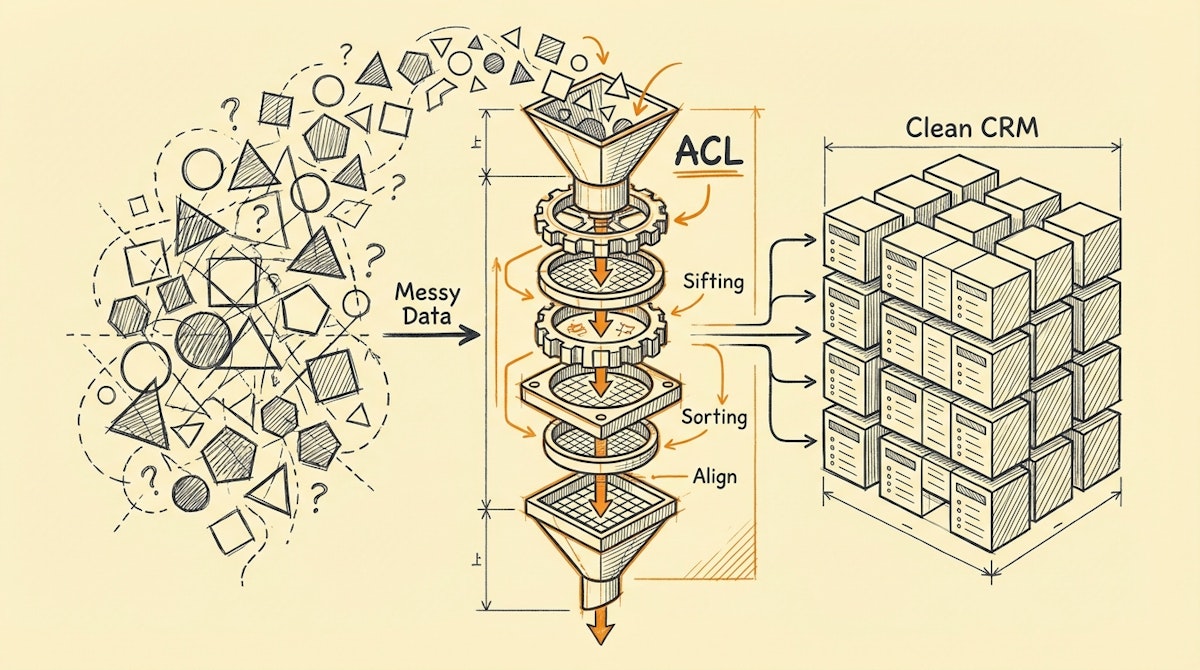
The ACL is a distinct middleware layer that translates data from an external system (which is often messy or "corrupt") into the internal model of your core system (your CRM or Database). Instead of your CRM adapting to the whims of every new lead form, the ACL forces the external data to conform to your strict internal standards before it ever touches the database.
It treats the CRM as a "Sanctuary" that must be protected.
The Architecture of a No-Code ACL
Implementing an ACL does not require a dedicated engineering team. In tools like Make or n8n, it functions as a standalone scenario that sits between the Source (e.g., Typeform) and the Destination (e.g., HubSpot).
| Metric | Direct Integration | Anti-Corruption Layer |
|---|---|---|
| Data Hygiene | Low (Source Dependent) | High (Strictly Enforced) |
| System Coupling | Tight (Brittle) | Loose (Flexible) |
| Error Handling | Silent Failures | Isolated & Logged |
The Process: Implementing the ACL
To build this effectively, I recommend breaking the automation into three distinct logical steps within your orchestration tool. This structure mimics the Facade and Adapter patterns found in traditional coding.
1. The Ingestion Facade (Raw Capture)
The first step is purely about capturing the payload without judgment. Whether the data comes via webhook, API polling, or a CSV drop, the goal is to store the Raw Payload immediately.
- Action: Receive data.
- Storage: Log the raw JSON to a temporary database (like Airtable or a PostgreSQL staging table) with a status of
Pending. - Why: If the transformation logic fails later, you never lose the original data packet. You can replay the event.
2. The Translation Adapter (Normalization)
This is the core of the ACL. Here, we apply rigid transformation rules to force the incoming data into our standard schema. This is where you prevent "pollution."
- Phone Normalization: Use a library (like
google-libphonenumberinside an n8n Code node or a dedicated Make module) to convert all numbers to E.164 format (+14155552671). - Title Standardization: Map incoming variations (
VP Sales,Vice President of Sales) to a finite list of approved picklist values (VP - Sales). If a match isn't found, default to a fallback (Unknown) rather than letting the messy string enter the CRM. - String Sanitization: Trim whitespace, sentence-case names (fixing "JOHN DOE"), and strip emojis.
3. The Gatekeeper (Validation & Loading)
Before the final push to the CRM, the data must pass a "Gatekeeper" logic block.
- Identity Resolution: Check if the user already exists. If they do, update only specific fields based on a hierarchy of trust (e.g., don't overwrite a verified email with a form submission).
- Business Rule Validation: Does the lead meet the minimum criteria? If the
Company Sizeis missing, perhaps we enrich it using a tool like Clearbit before the push, ensuring no incomplete records enter the sales queue. - The Commit: Only once all these checks pass is the data upserted into the CRM.
Why This Matters for Growth Engineers
The initial setup time for an ACL is higher than a direct Zap. However, the technical debt accrued from direct integrations is massive. Every time you change a field in your form, you risk breaking your CRM reporting.
By using an ACL, you protect your downstream systems (Marketing Automation, CRM, Data Warehouse) from upstream chaos. You gain the ability to swap out lead sources without refactoring your entire database schema. In the context of scaling operations, this separation of concerns is the difference between a fragile stack and a robust platform.
References
- Domain-Driven Design (Eric Evans): https://www.domainlanguage.com/ddd/
- Segment Data Quality: https://segment.com/product/protocols/
- Microsoft Anti-Corruption Layer Pattern: https://learn.microsoft.com/en-us/azure/architecture/patterns/anti-corruption-layer