Preventing CRM Data Decay With The Field-Level Authority Waterfall
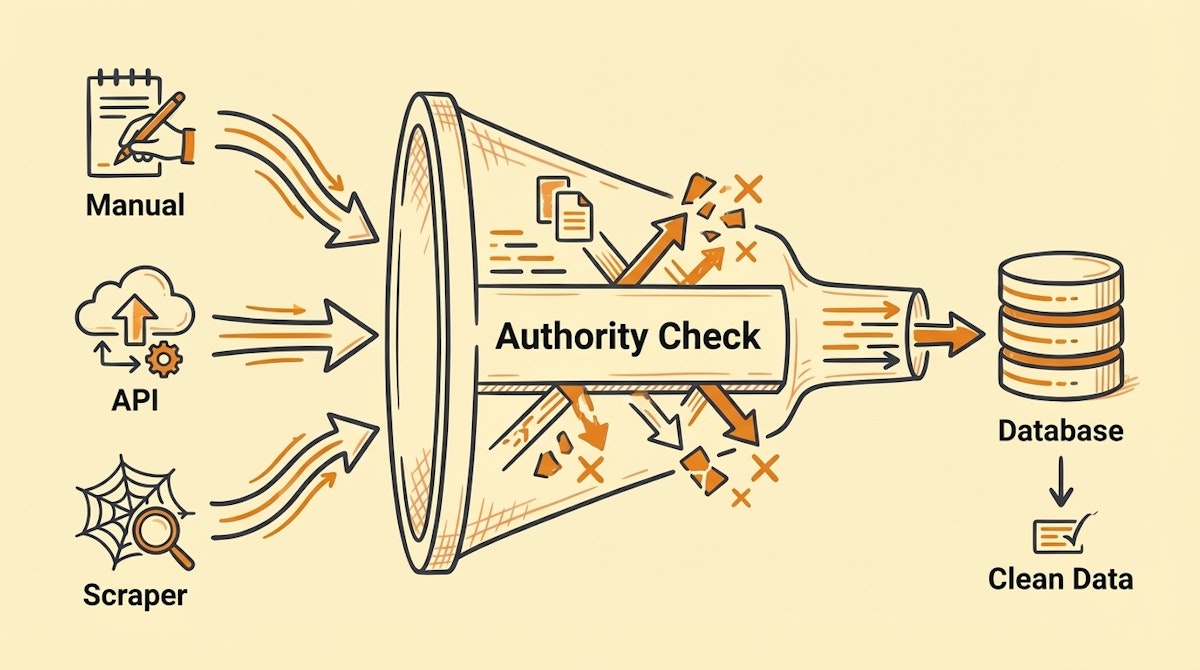
We often approach automation with a bias for speed: trigger a webhook, map the fields, and update the CRM. It feels efficient until a Sales Representative complains that the verified mobile number they manually collected at a conference was just overwritten by a generic switchboard number from a bulk enrichment tool.
This is a classic friction point in Sales Operations. We want to automate data enrichment to save time, but in doing so, we often introduce a "Blind Overwrite" mechanism that degrades data quality over time.
The mistake isn’t the automation itself; it’s the assumption that the most recent data point is always the most accurate.
In my experience, the solution lies in moving away from simple "Update Record" actions and implementing a logic layer I refer to as the Field-Level Authority Waterfall.
The Mistake: The "Latest is Greatest" Fallacy
The default behavior of most native integrations and simple Make/Zapier scenarios is to treat every incoming payload as the source of truth. If a lead form submission contains a job title, we map it to the Job Title field. If an enrichment tool returns a revenue figure, we map it to Annual Revenue.
This approach creates a race condition where the "winner" is simply the last system to trigger an update.
Why this fails:
- Context Loss: A manual entry by a human (high context) is treated the same as a scraper's output (low context).
- Data Regression: Valid data is replaced by null values or generic placeholders (e.g., changing "VP of Sales" to "Manager" because of a LinkedIn mismatch).
- Erosion of Trust: When Sales Reps see their work undone by "the system," they stop trusting the CRM and revert to spreadsheets.
The Solution: The Field-Level Authority Waterfall
The Field-Level Authority Waterfall is a logic structure that assigns a "trust score" or rank to every data source. Before an automation updates a field, it checks the rank of the incoming data against the rank of the existing data.
The update only executes if the Incoming Authority is greater than or equal to the Existing Authority.
Designing the Hierarchy
While every organization is different, a typical hierarchy might look like this (from highest authority to lowest):
- Locked/Manual: Data explicitly verified by a Sales Rep.
- Primary Data Provider: High-fidelity enrichment (e.g., Clearbit, ZoomInfo).
- Inbound Form: User-submitted data (often prone to typos but high intent).
- Secondary Inference: Scraped data or AI-inferred classifications.
- Empty/Null: The field is currently blank.
Implementing the Logic
To implement this, you generally need a middleware tool like n8n or Make, as native CRM integrations rarely support this level of granularity.
The Workflow:
- Trigger: New data arrives (e.g., from a form or enrichment tool).
- Fetch State: The automation retrieves the current record from the CRM, including the specific field values and, crucially, the
Last Modified Byor a customData Sourcemetadata field. - Compare Authority:
- If the current field is empty, Update.
- If the current field was set by "Enrichment" and incoming is "Manual", Update.
- If the current field was set by "Manual" and incoming is "Enrichment", Discard.
- Conditional Patch: Construct a JSON payload containing only the fields that passed the authority check.
| Feature | Blind Overwrite (Standard) | Authority Waterfall |
|---|---|---|
| Conflict Resolution | Last-in wins | Highest rank wins |
| Data Protection | None | Protects manual entries |
| Complexity | Low (Linear) | Moderate (Conditional) |
Handling "Stale" Authority
A common nuance I have observed is that high-authority data can still become stale. For example, a manual entry from three years ago might be "higher rank" than a fresh enrichment signal, but it is likely incorrect today.
To solve this, you can add a Time Decay Protocol to the Waterfall. If the Last Modified Date of the high-authority field is older than X months, its authority score downgrades, allowing newer, lower-authority automated data to overwrite it. This keeps the database fresh without sacrificing protection against immediate overwrites.
Conclusion
Shifting from blind updates to an authority-based model adds friction to the setup process. You have to build decision trees rather than straight lines. However, for a Sales Ops Manager, the goal isn't just moving data—it's maintaining a reliable system of record.
By respecting the hierarchy of data sources, we protect the efforts of the sales team and ensure that automation serves as a support system, not a saboteur.