Review: n8n’s Self-Hosted Architecture For Strict Data Governance
The Tension Between Speed and Sovereignty
I have observed a recurring friction in operations teams: the person building the automation wants speed, but the Data Analyst responsible for the reporting pipeline demands traceability. When we use standard SaaS automation platforms like Zapier or Make, we are effectively sending internal data to a third-party black box for processing. For many use cases, this is acceptable. However, when dealing with sensitive customer PII, financial records, or strict regulatory environments (GDPR, HIPAA), this "data offloading" becomes a governance nightmare.
In this review, I want to look at n8n specifically through the lens of the Data Analyst persona. While it is often marketed as a "workflow automation tool," I see it more as a low-code backend that offers a specific solution to the "black box" problem: Self-hosting and Source Control.
The Product: n8n (Fair-Code Workflow Automation)
Unlike its closed-source competitors, n8n operates on a "fair-code" model. It allows users to download the source code, run it on their own infrastructure (Docker, private cloud, or on-premise), and inspect exactly how data is processed. For a Data Analyst, this architectural difference changes the value proposition entirely. It shifts the tool from a "productivity hack" to a viable component of the enterprise data stack.
1. Data Residency and the "Air Gap"
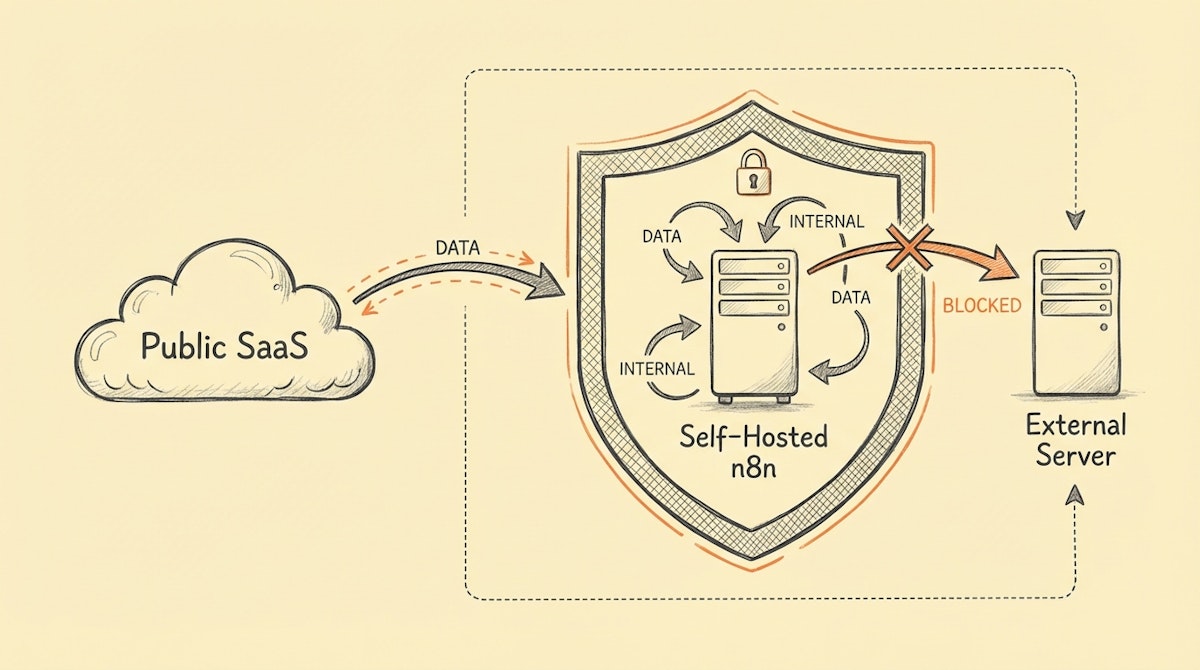
The primary governance challenge with SaaS iPaaS (Integration Platform as a Service) is that data must leave your controlled perimeter to be transformed. I have seen compliance teams block simple automations because they couldn't verify where the data was temporarily stored during execution.
n8n solves this by allowing you to deploy the execution engine within your own VPC (Virtual Private Cloud). This means:
- No Third-Party Logging: Execution data lives in your Postgres database, not on a vendor's server.
- Direct SQL Access: Since the automation engine sits next to your databases, you can query production DBs without opening firewalls to the public internet.
2. Treating Automations as Code (Git Integration)
One of the most fragile aspects of no-code automation is versioning. In many tools, if someone breaks a workflow, the "undo" button is limited, and there is no record of who changed what.
For an analyst accustomed to SQL queries and Python scripts, this lack of rigor is terrifying. n8n introduced Source Control features that integrate with Git repositories. This allows teams to:
- Commit Changes: Save versions of a workflow with commit messages explaining the logic change.
- Branching Strategies: Develop a new data pipeline in a "dev" environment and only merge it to "prod" after testing.
- Diff Views: Visually see what nodes were altered between versions.
This aligns automation with GitOps principles, bringing engineering-grade governance to low-code workflows.
3. Granular Execution Logging
Debugging a failed data transformation in a visual builder can be frustrating if you cannot see the exact JSON structure at every step. n8n provides deep visibility into the JSON execution data for every node. Instead of abstracting the data away, it exposes the raw arrays and objects.
For a Data Analyst, this is crucial. It allows for the validation of data types (e.g., ensuring a timestamp is ISO 8601 compliant before it hits the BI tool) and provides a clear audit trail of transformation errors.
Comparative Analysis: Governance Capabilities
Below is a comparison of how n8n stacks up against typical cloud-only iPaaS solutions regarding control and safety.
| Feature | n8n (Self-Hosted) | Standard SaaS iPaaS |
|---|---|---|
| Data Residency | User Infrastructure (Private) | Vendor Cloud (Shared) |
| Version Control | Git Integration (Commits) | Simple Rollback History |
| Execution Limits | Server Hardware Limited | Plan/Quota Limited |
| Auditability | Full DB Access to Logs | UI-Only Log Access |
The Trade-off: Maintenance Overhead
It is important to acknowledge the cost of this control. Managing a self-hosted n8n instance requires DevOps effort. You are responsible for updates, uptime, and server security. For a solo Data Analyst without engineering support, this might introduce friction compared to the "set and forget" nature of managed SaaS tools.
However, in the context of the Governance, Resilience, and Auditing theme, this trade-off is often necessary. The ability to guarantee that customer data never touches a third-party server is a powerful enabler for automating regulated workflows.
Conclusion
If your primary goal is simple personal productivity, n8n's setup might be overkill. But for the Data Analyst tasked with building resilient, auditable reporting pipelines, n8n offers a level of governance that standard tools cannot match. By treating workflows as code and keeping execution local, it bridges the gap between the ease of low-code and the rigor of data engineering.
Implementing tools like n8n is often the first step toward assembling the low-code ETL toolkit, ensuring that as your automation portfolio grows, your ability to audit and control it scales alongside.
References
- n8n Homepage: https://n8n.io
- GitOps Principles: https://about.gitlab.com/topics/gitops/