Review: Clay as the Strategic Data Orchestration Layer for CRM Integrity
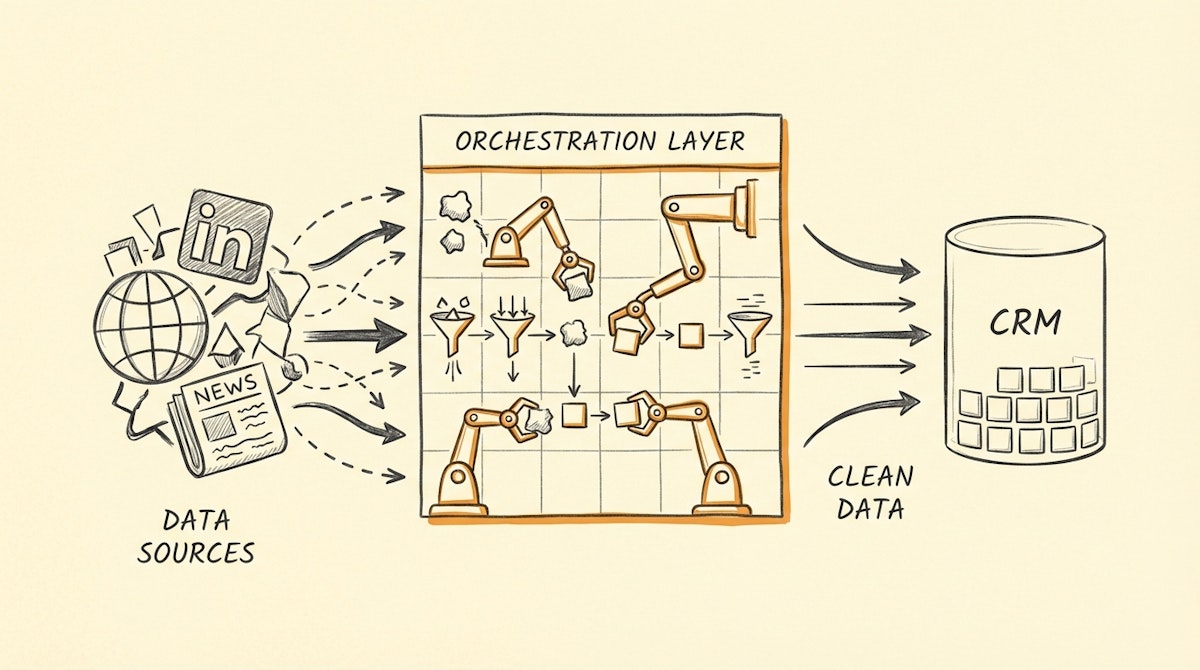
Managing a CRM often feels like fighting a losing battle against entropy. As a Sales Ops Manager, you are likely familiar with the cycle: you clean the data, set up validation rules, and within a month, the integrity degrades again. Sales reps bypass required fields to close deals faster, or they simply don't have the time to research the obscure details that marketing needs for segmentation.
From what I have observed in the automation space, the traditional approach—relying on static databases like ZoomInfo or Apollo alone—is reaching its limits. These tools provide a baseline, but they don't solve the specific context required for high-value sales motions. This is where Clay has emerged, not just as a data provider, but as what I call a "Data Orchestration Layer."
In this review, I want to assess Clay through the lens of strategic alignment: does it actually help Sales Ops standardize processes and realize value, or is it just another subscription to manage?
The Shift: From Static Lists to Dynamic Waterfalls
The core value proposition of Clay, when looked at from an architectural perspective, is the Waterfall Enrichment concept. Instead of buying a static list, you are building a dynamic process.
Most Sales Ops teams I talk to are struggling with data coverage. One provider might have good emails but bad phone numbers. Another might have great firmographics but lacks decision-maker data. Historically, solving this meant managing three different vendor contracts and manually merging CSVs.
Clay abstracts this by allowing you to chain providers. You can query a low-cost provider first; if no result is found, the system automatically queries a premium provider. This logic aligns perfectly with cost-optimization strategies in operations. You only pay for the premium data when the cheaper option fails.
The AI Worker: Standardization at Scale
The most compelling feature for an Ops professional is the integration of LLMs (like GPT-4 or Claude) directly into the spreadsheet interface. This moves beyond simple data retrieval into semantic processing.
Consider the "Job Title" problem. In your CRM, you want standardized roles (e.g., "VP of Sales"). On LinkedIn, prospects write "Head of Revenue & Growth 🚀".
I have seen teams waste hours manually normalizing this. In Clay, you can define a prompt to normalize these diverse inputs into a strict set of dropdown values before the data ever touches your CRM. This ensures that your reporting and forecasting remain accurate because the inputs are standardized at the source.
Feature Analysis: Operational Impact
To understand where Clay fits in the stack, it is helpful to compare it against the traditional methods of data acquisition.
| Feature | Static Database (Legacy) | Clay (Orchestration) |
|---|---|---|
| Data Freshness | Updated Quarterly/Yearly | Real-time (Live Scraping) |
| Cost Structure | High Fixed License | Usage-based Waterfalls |
| Data Normalization | None (Raw Output) | LLM-based Formatting |
| Flexibility | Rigid Schema | Fully Programmable |
The Strategic Trade-offs
While Clay offers significant power, it is not without operational friction. It is important to be realistic about the learning curve. This is not a tool you simply hand to a non-technical Sales Development Rep (SDR). It requires a "builder" mindset—someone who understands data types, API logic, and logical operators.
Pros:
- Consolidated Billing: You can access dozens of data providers (Clearbit, People Data Labs, etc.) without separate contracts.
- Deep Research: The "Claygent" agent can visit websites to answer specific questions (e.g., "Does this company use Stripe?"), automating a task that usually consumes valuable rep time.
- Agility: You can change your qualification criteria in minutes by adjusting a prompt, rather than waiting for IT to update CRM fields.
Cons:
- Credit Consumption: It is very easy to burn through credits if you do not structure your waterfalls correctly. A mistake in logic can be costly.
- Complexity: It acts more like a database/spreadsheet hybrid than a simple list tool. It requires an owner in Sales Ops to manage it effectively.
Conclusion: A Protocol for Integrity
For the Sales Ops Manager focusing on Strategic Alignment, Clay represents a move away from "data entry" toward "data engineering." By implementing Clay as a buffer between the raw web and your CRM, you act as a gatekeeper.
Instead of asking reps to fix data, you automate the hygiene process upstream. This allows you to present leadership with a "Source of Truth" that is actually true, fulfilling the core mandate of the Sales Ops role.
References
- Clay: https://www.clay.com
- ZoomInfo: https://www.zoominfo.com
- Apollo: https://www.apollo.io
- People Data Labs: https://www.peopledatalabs.com