Heuristic Scoring vs. Semantic Analysis: The Lead Qualification Standoff
Introduction
For any Sales Ops Manager, the definition of a "Qualified Lead" is a moving target. We usually rely on rigid point systems inside our CRM: if a job title contains "VP", add 10 points. If the company size is over 50 employees, add 5 points. If they downloaded a PDF, add another 5.
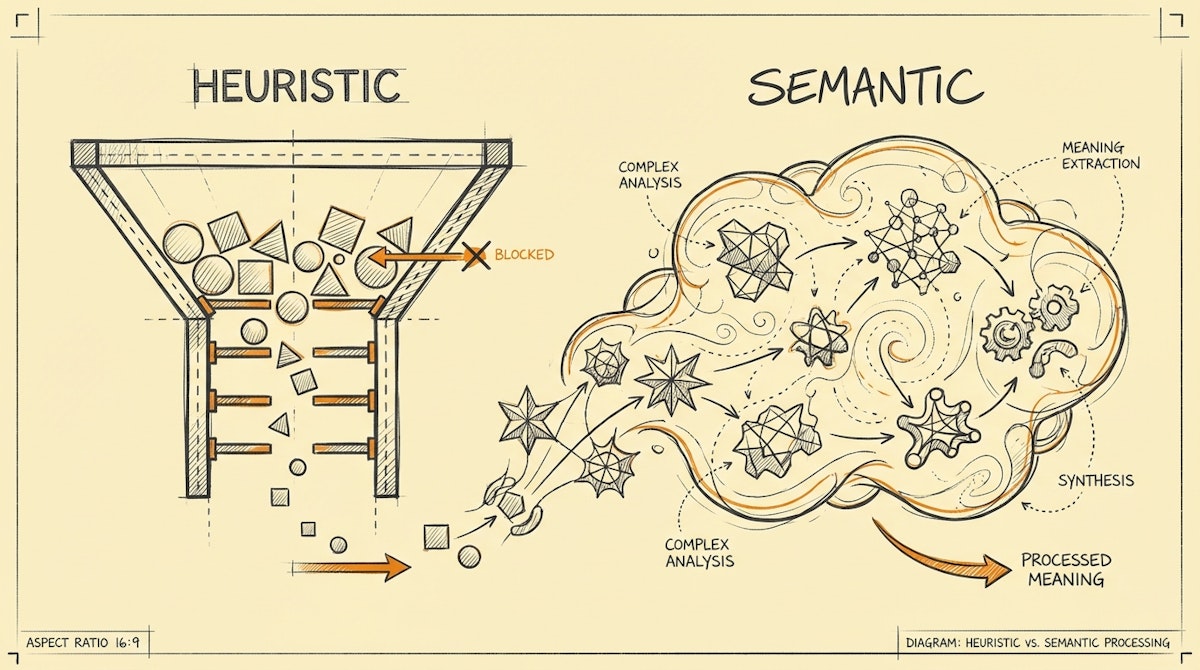
This is Heuristic Scoring. It is fast, deterministic, and native to almost every CRM from HubSpot to Salesforce. But it is also context-blind. It cannot tell the difference between a "VP of Engineering" at a 3-person startup and a "VP of Engineering" at a multinational enterprise, often resulting in false positives that frustrate sales reps and dilute their trust in the system.
Recently, I have been experimenting with Semantic Analysis—using LLMs (like GPT-4 or Claude 3) via automation platforms (Make, n8n) to qualitative evaluate leads. Instead of checking if a field contains text, we ask the model to interpret the prospect's profile.
This post compares these two methodologies to help you decide when to stick to the rules and when to introduce AI into your lead routing architecture.
The Contenders
1. Heuristic Scoring (The Rule-Based Approach)
This is the status quo. You define a set of logic gates based on explicit data points. This relies heavily on data enrichment providers (like Clearbit or ZoomInfo) filling in the blanks before your rules run.
- The Mechanism: Boolean Logic (IF/THEN).
- The Input: Structured fields (Industry, Employee Count, Job Title).
- The Typical Use Case: Filtering out students, competitors, or clearly unqualified domains (e.g., @gmail.com) before a lead reaches a rep.
2. Semantic Analysis (The LLM Approach)
This approach uses a Large Language Model to act as a "virtual researcher." You pass unstructured data—such as a LinkedIn bio, a company description scrape, or the content of a "Contact Us" message—and ask the model to score the fit based on a persona definition.
- The Mechanism: Probabilistic Inference.
- The Input: Unstructured text and nuance.
- The Typical Use Case: Determining if a company is B2B or B2C, or judging if a "Project Manager" actually holds budget authority based on their specific responsibilities listed on LinkedIn.
Side-by-Side Comparison
While the industry buzz, championed by companies like MadKudu (who specialize in predictive scoring), is moving toward complex modeling, you can build your own version of these systems using low-code tools. However, the trade-offs are significant.
| Feature | Heuristic Scoring | Semantic Analysis |
|---|---|---|
| Setup Complexity | Low (CRM Native) | High (Requires Prompt Eng) |
| Cost per Lead | Zero (Internal Logic) | Variable (API Token Costs) |
| Latency | Instant (Milliseconds) | Slow (5-15 Seconds) |
| False Positives | High (Context Blind) | Low (Context Aware) |
| Maintenance | High (Endless rule tweaks) | Medium (Prompt Drift) |
The Core Trade-Off: Speed vs. Context
Where Heuristic Wins: Speed & Volume
If you are processing inbound leads that require an immediate response (e.g., a "Book a Demo" calendar router), Semantic Analysis is dangerous. Waiting 10 to 15 seconds for GPT-4 to analyze a bio can cause timeouts in your form submission or routing tools. Heuristic scoring is instant. If a lead comes in with 5,000 employees, you route them to Enterprise immediately. Speed prevents lead leakage.
Where Semantic Wins: Nuance & Prioritization
I often see Heuristic scoring fail in "Edge Case Hell." For example, a company might sell "Automation Software." A keyword search for "Automation" might flag a lead as a competitor. However, a Semantic analysis would read their website and realize they sell "Home Automation Hardware," which is not a competitor to a B2B SaaS platform. Semantic analysis excels at the review stage—deciding which of the 100 leads a rep should call first.
The Hybrid Strategy: The "Waterfall" Filter
Rather than choosing one, the most robust architecture I have observed is a Waterfall Approach.
- Stage 1: The Kill Switch (Heuristic). Use simple logic to auto-reject obvious junk (bad emails, competitors, out-of-geo). This costs nothing and protects your API budget.
- Stage 2: The Fast Track (Heuristic). If a lead meets "Perfect" criteria (Fortune 500 domain), route immediately. Do not wait for AI.
- Stage 3: The Enrichment (Semantic). For the "Grey Zone" leads—those that look okay but aren't obvious—trigger a Make/n8n webhook. Send the data to an LLM with a prompt like: "Analyze this company description. On a scale of 1-5, how relevant is their business model to our product? Output JSON."
Conclusion
Heuristic scoring is about exclusion (filtering out the noise cheaply). Semantic analysis is about selection (finding the signal in the noise).
For Sales Ops, moving 100% to LLM-based scoring is likely overkill and introduces latency risks. However, layering semantic analysis on top of your existing heuristic rules can significantly reduce the "junk" that slips through to your SDRs, improving trust in your CRM data without over-engineering the entire pipeline.