Comparison: Proxy Metrics vs. Value-Based Signals For Profit Alignment (Ref: Google)
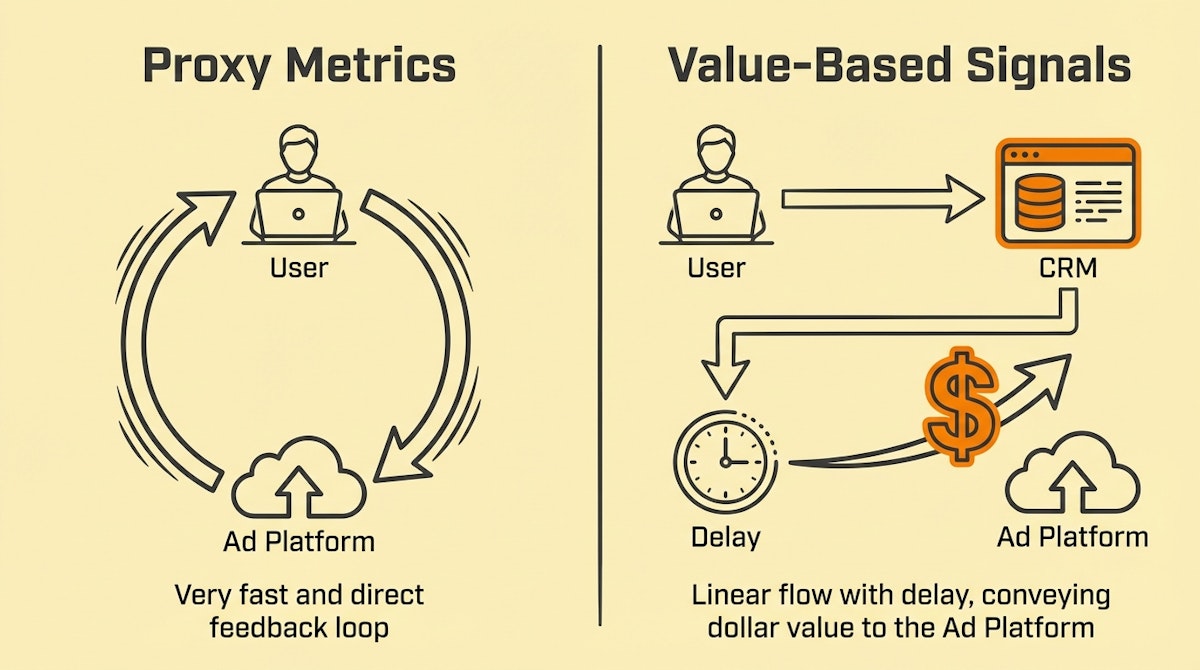
We often fall into the trap of celebrating the wrong wins. I see it constantly in growth reviews: the marketing team is high-fiving over a record-low Cost Per Lead (CPL), while the sales team is frustrated by a pipeline full of unqualified prospects who will never buy.
This is the classic misalignment between Proxy Metrics (indicators of interest) and Value-Based Signals (indicators of revenue).
For the Growth Engineer, the challenge isn’t just buying traffic; it’s building the technical infrastructure to tell ad platforms what a "good" user actually looks like after the click. If we treat every signup as equal, algorithms will optimize for the easiest, cheapest signups—often at the expense of quality.
This post compares the standard optimization approach (Proxy Metrics) against the mature, revenue-aligned approach (Value-Based Signals) and explores how we can bridge the gap using automation tools like Make or n8n.
The Core Conflict: Volume vs. Value
The fundamental issue is the feedback loop. Ad platforms (Meta, Google, LinkedIn) are incredibly good at finding more of whatever you feed them.
- Proxy Metrics (Standard Pixel Tracking): You fire an event immediately when a user hits a "Thank You" page. The feedback loop is instant. The algorithm learns fast. However, it assumes all leads are worth the same.
- Value-Based Signals (Offline Conversions): You wait until a lead is qualified, scores high in your CRM, or makes a purchase. You then send that data back to the ad platform server-side. The loop is delayed, but the signal is accurate.
I have observed that moving to Value-Based Signals is rarely a marketing challenge; it is a data engineering challenge.
Comparison: The Technical Trade-offs
Moving from client-side proxy tracking to server-side value optimization requires a shift in how we architect our data pipelines.
| Feature | Proxy Metrics (Pixel) | Value-Based Signals (CAPI) |
|---|---|---|
| Optimization Goal | Maximize Volume (CPL) | Maximize Profit (ROAS) |
| Feedback Speed | Real-time (Seconds) | Delayed (Hours/Days) |
| Engineering Load | Low (Copy/Paste Script) | High (API Integration) |
| Data Privacy | Vulnerable (Browser-based) | Secure (Server-to-Server) |
The Architecture Gap
The reason most teams stick to Proxy Metrics is that Value-Based Signals require maintaining state. You cannot simply fire a tag. You must:
- Capture the Click ID: Store the
gclidorfbclidin your CRM or database when the user first arrives. - Wait for the Event: Let the user journey play out (e.g., Sales changes status to "Qualified").
- Hydrate & Send: Trigger an automation that looks up the original Click ID, attaches the real monetary value (e.g., the potential deal size), and pushes it back to the ad network's Conversion API.
Strategic Alignment Strategy
To bridge this gap without building a full data warehouse, I’ve seen success using a "Hybrid Optimization" strategy.
Phase 1: Cold Start (Proxy) New campaigns need data fast. Relying solely on deep-funnel value signals (which are sparse) can starve the algorithm. We use Proxy Metrics (e.g., "Account Created") to get volume.
Phase 2: The Value Layer (Value-Based) Once volume stabilizes, we layer in the server-side signals. Using tools like n8n or Make, we build a listener on the CRM (e.g., Salesforce/HubSpot).
- Trigger: Deal Stage changes to "Negotiation".
- Action: Calculate
Predicted_Value(Deal Amount * Probability). - Push: Send payload to Google Offline Conversion Import (OCI) or Meta Conversions API.
This teaches the ad platform: "Ignore the cheap leads who signed up but had zero budget. Go find more people like the ones who actually reached the negotiation stage."
Conclusion
Strategic alignment in automation isn't just about moving data faster; it's about moving the right data.
By shifting from Proxy Metrics to Value-Based Signals, we accept a trade-off: we sacrifice the simplicity of client-side pixels for the reliability of server-side truth. The benefit isn't just better ad performance; it is trust. When marketing reports on value generated rather than just "leads delivered," the friction between growth and sales dissolves.
References
- Google Ads Help: About value-based bidding
- Meta for Developers: Conversions API
- Segment: The difference between client-side and server-side tracking