Assembling the Composable Attribution Stack to Align Spend with Revenue
Attribution is rarely a technical problem; it is a trust problem.
I have observed that for many Growth Engineers, the friction isn't just about collecting data—it's about getting the rest of the organization to believe in the data. Marketing dashboards show one set of conversion numbers, the CRM shows another, and the Finance team has a third spreadsheet that doesn't match either.
When these numbers diverge, strategic alignment breaks down. You cannot optimize what the organization cannot agree on.
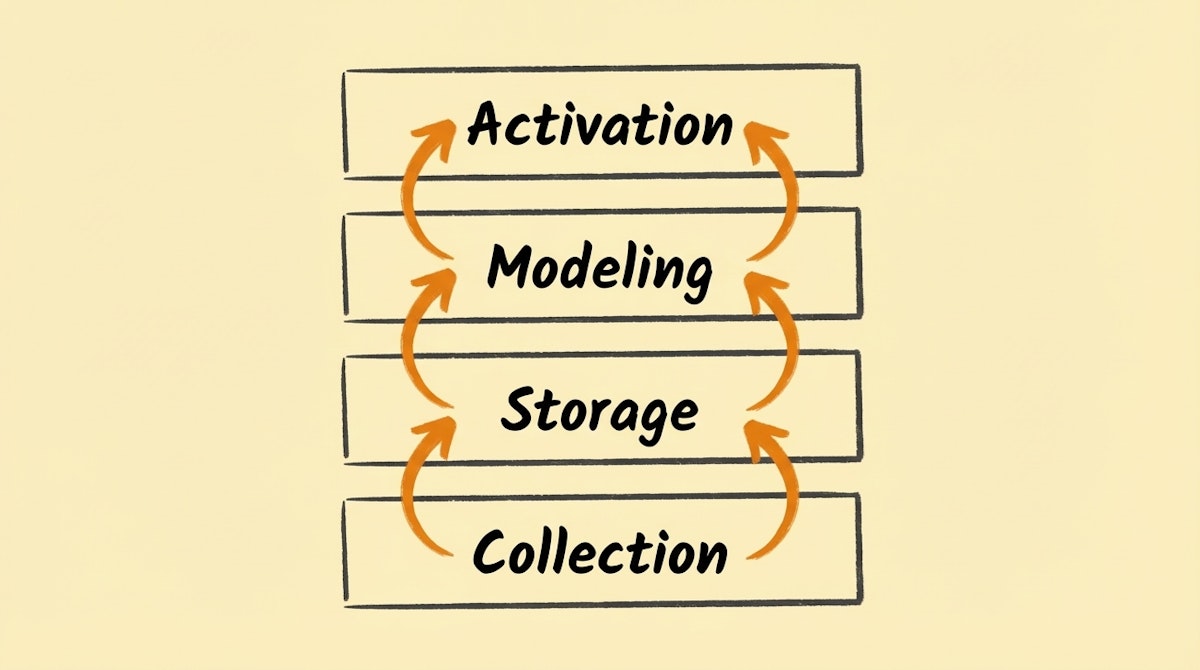
The historical solution was to buy expensive, monolithic attribution software (like early-era Attribution App or heavily customized GA360 setups). However, the modern approach seems to be shifting toward a Composable Attribution Stack. This is a "Toolkit" approach where you assemble best-in-class components to ingest, store, model, and activate data, ensuring that the logic is transparent rather than hidden inside a proprietary black box.
Here is a look at the components of a composable stack designed to solve the value realization gap.
1. The Collection Layer: Moving Beyond Client-Side Chaos
The first tool in the stack must solve the identity resolution crisis caused by ITP (Intelligent Tracking Prevention) and cookie blocking. Relying solely on client-side pixels is no longer viable for accurate strategic planning.
The Tool: RudderStack (or Segment)
Why it fits the toolkit: Unlike a standard analytics tool that traps data in its own UI, RudderStack acts as a pipeline. It collects events (page views, clicks, form submits) and identifies users across devices. Crucially for the Growth Engineer, it offers robust server-side tracking capabilities, which helps mitigate data loss from ad blockers.
The Strategic Value: It creates a reliable "first mile" of data. If the input is flawed, the ROI calculation downstream will always be rejected by the CFO.
2. The Storage Layer: The Single Source of Truth
To align marketing spend with actual business value, event data needs to live where the financial data lives.
The Tool: BigQuery or Snowflake
Why it fits the toolkit: You need a warehouse where you can join the "Anonymous Visitor ID" from your collection layer with the "Closed Won" opportunity in your CRM.
The Strategic Value: Centralization. By dumping raw event data into the same warehouse as your Salesforce or HubSpot data, you eliminate the "my dashboard vs. your dashboard" argument. There is only one dataset.
3. The Modeling Layer: Defining Logic Openly
This is the most critical part of the stack for alignment. In a black-box tool, the vendor decides how to weigh a touchpoint. In a composable stack, you define the logic.
The Tool: dbt (Data Build Tool)
Why it fits the toolkit: dbt allows you to write SQL queries that transform raw data into modeling tables. You can write the logic for "Time Decay" or "Position Based" attribution yourself.
The Strategic Value: transparency. If a stakeholder asks, "Why did this campaign get credit?", you don't say "The algorithm did it." You show them the SQL logic in the dbt repo. It turns attribution into an auditable process.
4. The Activation Layer: Closing the Feedback Loop
Calculating ROI is useful for reporting, but the Growth Engineer needs to push that value back into the ad platforms to optimize bidding algorithms.
The Tool: Hightouch or n8n (for custom reverse ETL)
Why it fits the toolkit: These tools query your warehouse (where the "true" conversions are confirmed) and push that data back to Google Ads, Meta CAPI, or LinkedIn Offline Conversions.
The Strategic Value: This allows you to bid on profit, not just leads. It aligns the ad platform's algorithm with the company's actual revenue goals.
Comparing Approaches
When deciding between a pre-packaged attribution tool and this composable toolkit, the trade-off usually comes down to setup time versus long-term trust.
| Factor | Monolithic SaaS | Composable Toolkit |
|---|---|---|
| Logic Visibility | Opaque (Black Box) | Transparent (SQL) |
| Data Ownership | Vendor Lock-in | Owned (Warehouse) |
| Flexibility | Low (Fixed Models) | High (Custom Models) |
Conclusion
The goal of this stack isn't just to produce a report; it is to realize value. By decoupling collection, storage, modeling, and activation, the Growth Engineer moves from being a "consumer of charts" to an "architect of truth."
While this requires more engineering effort upfront, the resulting clarity enables the organization to confidently scale spend on channels that are actually driving revenue, rather than those that just claim credit for the last click.
References
- RudderStack (Collection): https://www.rudderstack.com
- dbt (Modeling): https://www.getdbt.com
- Reforge (Growth Strategy): https://www.reforge.com
- Hightouch (Reverse ETL): https://hightouch.com